The week in the markets - September 18, 2026

- The U.S. Federal Reserve delivered its first interest rate increase since 2023.
- Middle East infrastructure attacks lifted Brent oil near $107 and U.S. 10-year Treasury yields past 5%.
- The European Commission invited Canada to explore an associate membership partnership.
The U.S. Federal Reserve delivered its first rate increase since 2023. An attack on Saudi infrastructure lifted Brent oil past $107 and pushed the U.S. 10-year Treasury yield above 5%. Brussels offered associate membership to Canada; Washington called it a hostile act.
Why did the U.S. Federal Reserve raise its interest rate?
The U.S. Federal Reserve (the Fed) raised its benchmark interest rate by a quarter of a percentage point Wednesday to a range of 3.75% to 4%, its first increase since July 2023. The vote was unanimous at 12-0. Furthermore, 16 of 18 Fed policymakers expect another rate increase this year, four of them see two, and no increases appear in the years that follow. Inflation forecasts crept higher, to 3.7% headline PCE (Personal Consumption Expenditures Price Index) and 3.4% core.
Fed Chair Kevin Warsh described the decision as “removing a dose of accommodation” and repeated that this summer’s readings give him no evidence that underlying inflation trends have improved. Stocks were flat on the initial announcement and dipped lower while he spoke.
U.S. President Trump selected Warsh expecting lower rates and said days earlier that no country should have rates lower than America’s. Warsh voted to raise them anyway. A Fed chair establishing independence this early will change how markets read every meeting from here, removing the assumption that the White House is setting the ceiling on rates.
How high did 10-year Treasury yields climb?
The case for raising rates strengthened during the week. Houthi forces seized more islands along Red Sea shipping lanes, and an attack knocked Saudi Arabia’s East-West pipeline offline, with officials saying repairs will run for weeks. The supply shock has widened from Iranian waters to Saudi infrastructure. Brent crude oil traded close to $107 per barrel.
U.S. 10-year Treasury yields pushed above 5% Tuesday, near a two-decade high. That level will affect every discount rate in every type of bond, arriving in the same week the Fed raised its interest rate.
Canadian stocks felt it; The S&P/TSX closed Monday at 35,703 after a mixed domestic inflation report, then slid by 0.67% Tuesday (with energy providing the only real support), following its worst weekly decline since March. The index that spent the summer outrunning the S&P 500 is now being tested by the same oil prices that lifted it.
What’s happening with Canada and the E.U.?
The biggest Canadian news had nothing to do with rates. In her state of the union address Wednesday, European Commission President Ursula von der Leyen invited Canada to become the European Union’s first associate member and described it as an alliance for the future. Prime Minister Mark Carney addressed the European Parliament in Strasbourg Thursday, welcomed the ambition (though he ruled out full membership) and proposed joining Erasmus+ and Horizon Europe. He committed to a parliamentary debate and vote.
Trump called the idea a hostile act and laughable. Carney answered that Canada and Europe are no fair-weather allies, and that a deeper European partnership will make Canada a better partner to the United States.
Will the Fed keep raising interest rates?
After a week when the Fed finally moved its rate and Ottawa went shopping for new partners, the question now is how much higher the price of oil needs to go before one rate increase becomes a cycle.
Listen to the latest podcast from the IG Investment Strategy Team for further insights.
The Week in the Markets Commentary
Read the complete report for further details on weekly performance and international market trends.
Read Full CommentaryThis commentary is published by IG Wealth Management. It represents the views of our Portfolio Managers, and is provided as a general source of information. It is not intended to provide investment advice or as an endorsement of any investment. Some of the securities mentioned may be owned by IG Wealth Management or its mutual funds, or by portfolios managed by our external advisors. Every effort has been made to ensure that the material contained in the commentary is accurate at the time of publication, however, IG Wealth Management cannot guarantee the accuracy or the completeness of such material and accepts no responsibility for any loss arising from any use of or reliance on the information contained herein. Investment products and services are offered through IG Wealth Management Inc. (in Québec, a firm in financial planning), a member of the Canadian Investor Protection Fund. Commissions, fees and expenses may be associated with mutual fund investments. Read the prospectus before investing. Mutual funds are not guaranteed, values change frequently and past performance may not be repeated.
This document may include forward-looking statements based on certain assumptions and reflect current expectations. Forward-looking statements are not guarantees of future performance and risks and uncertainties often cause actual results to differ materially from forward-looking information or expectations. Some of these risks are changes to or volatility in the economy, politics, securities markets, interest rates, currency exchange rates, business competition, capital markets, technology, laws, or when catastrophic events occur. Do not place undue reliance on forward-looking information. In addition, any statement about companies is not an endorsement or recommendation to buy or sell any security.
Trademarks, including IG Wealth Management, are owned by IGM Financial Inc. and licensed to its subsidiary corporations.
© 2026 IGWM Inc. Reproduction or distribution of this commentary in any manner without the express written consent of IG Wealth Management is strictly prohibited.
Is saving for your child’s education still worth it? The research say yes

- Post-secondary education provides substantial income advantages and protects against automation and job displacement.
- High student debt burdens delay major life milestones and create ongoing mental and financial strain.
- RESPs offer flexible funding options across universities, colleges, apprenticeships, and skills training programs.
Parents today are tasked with a daunting challenge: preparing their children for a future they can’t predict. The world kids will enter as adults looks nothing like the one their parents grew up in. Artificial intelligence is already transforming work, entire industries are being disrupted, and the skills that made previous generations successful may not be the ones children will need.
This uncertainty collides with harsh financial realities across every aspect of life. Families are already juggling mortgage payments, child care costs and rising living expenses in an increasingly expensive world. Add to this that the Canadian Scholarship Trust estimates a four-year university degree could cost as much as $192,000 by 2042.
It raises a crucial question: is putting your hard-earned dollars toward education savings still the right choice? The answer, according to extensive research, is a resounding yes, and the benefits extend far beyond what most parents realize.
Post-secondary grads earn more, live longer and give back more to society
Post-secondary education — whether college, university or apprenticeships — delivers powerful career advantages that remain robust even as the economy evolves. Canadians with post-secondary credentials consistently enjoy higher employment rates and earn more than those with high school education alone.
As automation and AI transform the workforce, education provides crucial protection. Research from Statistics Canada shows that only 3-4% of university graduates face high risk of job displacement, compared to 33% of workers without post-secondary education.
Graduates also live significantly longer and healthier lives, form more stable relationships, and engage more actively in civic and community organizations. Post-secondary education is associated with stronger families and communities across generations.
The true cost of student loans goes beyond interest payments
In Canada, post-secondary graduates who carry debt average tens of thousands of dollars in student loans. That burden doesn’t just take years to repay; it can fundamentally alter life trajectories. Research shows debt-burdened graduates are pressured to prioritize immediate earnings over meaningful work, are significantly less likely to start businesses, and are more likely to delay home ownership, marriage and having children.
Rather than trying to predict the future or guess which specific careers will matter most, Registered Education Savings Plans (RESPs) offer an optimistic approach: invest in your child’s potential. RESPs can be used for university, college, apprenticeships or skills training programs, ensuring your child graduates with critical thinking and problem-solving abilities without heavy debt burden.
You can’t predict the future but you can prepare your child to create it
By saving early and consistently for your child’s education, you’re empowering them to build their future, pursue their passions, and contribute to making the world better, whatever direction their interests and talents may take them.
Start Planning for Education Savings
Speak with an advisor to set up an RESP strategy tailored to your family's future goals.
Read Full ArticleThis article was written by Peter Lewis from MoneySense and was legally licensed through the DiveMarketplace by Industry Dive. Written and published by IG Wealth Management as a general source of information only. Not intended as a solicitation to buy or sell specific investments, or to provide tax, legal or investment advice. Seek advice on your specific circumstances from an IG Wealth Management Advisor.
Trademarks, including IG Wealth Management and IG Private Wealth Management, are owned by IGM Financial Inc. and licensed to subsidiary corporations.
Helping your children buy their first home

- Gifting money for a down payment is tax-free in Canada but requires proper documentation and family property protection.
- Structuring support as a loan or co-signing a mortgage carries distinct legal, credit, and financial risks.
- Utilizing registered options like FHSAs, RRSP Home Buyers' Plans, and TFSAs maximizes tax efficiency.
With Canadian real estate prices continuing to climb — especially in major urban centres — many young adults are finding it increasingly difficult to break into the housing market. For parents who have the financial means, offering support can make a big difference. There are several ways to help your children buy their first home. However, it’s important to consider the financial, legal and emotional implications of each option before making a decision.
Gifting money for a down payment
The most straightforward way to help is to give your child money for a down payment. In Canada, there’s no gift tax, so you won’t pay tax on the amount you give, and your child doesn’t need to report it as income. But there are still a few important things to keep in mind:
- Documentation: Mortgage lenders often ask for a gift letter confirming the money is a gift, not a loan that needs to be repaid, to ensure debt service ratios are accurate.
- Family property risks: If your child later separates or divorces, gifted money used to purchase a home could become part of family property and be shared with a partner unless protected by a domestic contract (such as a marriage contract or cohabitation agreement).
- Impact on your finances: Ensure you are not compromising your own financial plan before making a significant cash gift.
Providing a loan instead of a gift
If you’re not comfortable giving the money outright, you could structure it as a loan formalized with a promissory note outlining repayment terms and interest rates.
- Pros: You retain legal rights to the funds, can include terms that protect the money upon relationship breakups, and maintain equity if you have multiple children.
- Cons: Loan repayment obligations are included in lender debt servicing calculations, which could impact your child’s ability to qualify for a mortgage.
Co-signing a mortgage
Co-signing can help your child qualify for a mortgage based on your income. However, co-signing makes you legally responsible for the full loan if your child defaults, which can impact your credit score and limit your future borrowing capacity.
Tax-free savings options
Before giving cash directly, explore whether your child is maximizing tax-advantaged accounts:
- First Home Savings Account (FHSA): Allows saving up to $8,000 annually ($40,000 lifetime) with tax-deductible contributions and tax-free withdrawals for a first home.
- Registered Retirement Savings Plan (RRSP): Under the Home Buyers' Plan (HBP), your child can withdraw up to $60,000 tax-free from an RRSP, repayable over 15 years.
- Tax-Free Savings Account (TFSA): Gifted funds can grow tax-free inside a TFSA and be withdrawn anytime for a home purchase.
Family dynamics and estate planning
When helping one child, consider how it impacts family dynamics. Many parents choose to track lifetime gifts or loans and equalize amounts within their will or estate plan to maintain fairness among children.
Planning Your Home Purchase Strategy
Speak with an advisor to review the best strategies for supporting a first-time home purchase without impacting your retirement.
Read Full ArticleWritten and published by IG Wealth Management as a general source of information only. Not intended as a solicitation to buy or sell specific investments, or to provide tax, legal or investment advice. Seek advice on your specific circumstances from an IG Wealth Management Advisor.
Mortgages are offered by Investors Group Trust Co. Ltd., a federally regulated trust company, and brokered by nesto Inc. Licences: Mortgage Brokerage Ontario #13044, Saskatchewan #316917, New Brunswick #180045101, Nova Scotia #202507230; Mortgage Brokerage Firm Quebec #605058; British Columbia, Alberta, Manitoba, Newfoundland/Labrador, PEI, Yukon, Nunavut, Northwest Territories.
Trademarks, including IG Wealth Management and IG Private Wealth Management, are owned by IGM Financial Inc. and licensed to subsidiary corporations.
Earnings, AI and emerging markets found another gear
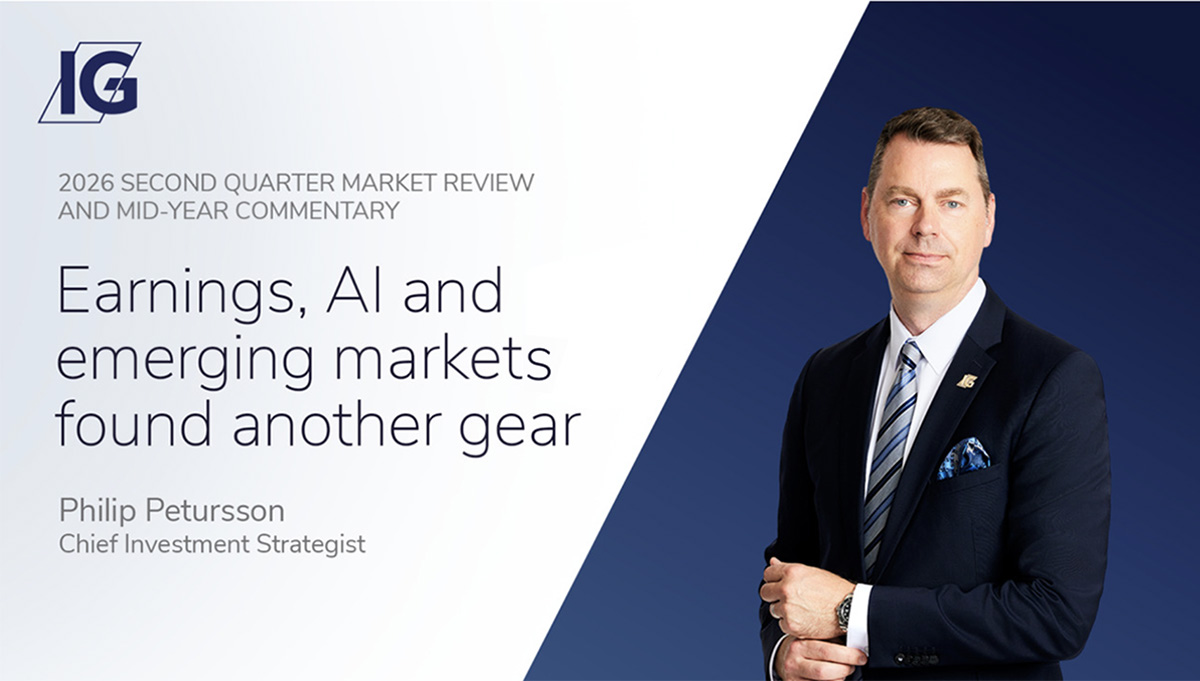
- Market fundamentals were able to overcome geopolitical tensions.
- The U.S. and Canadian stock markets both saw considerable growth.
- Market strength expanded beyond AI and tech companies.
- Emerging markets, led by South Korea and Taiwan, had a strong quarter.
- Fixed income markets were relatively quiet.
- The outlook for the remainder of 2026 looks positive.
The second quarter of 2026 (and the first half of the year more broadly) offered investors a reminder that markets are often driven by fundamentals rather than headlines. Geopolitical tensions, volatile energy prices and shifting interest-rate expectations dominated the news cycle, yet global equities continued to advance as corporate earnings and economic activity remained stronger than expected. The result was a quarter defined less by the risks investors faced and more by the market's ability to absorb them.
How were earnings for U.S. and Canadian companies?
At the centre of the story was earnings growth. The S&P 500 gained 14.9% in U.S. dollar terms (13.4% in Canadian-dollar terms), while the S&P/TSX Composite Index advanced by 6.4%. The strength in equities was supported by resilient earnings expectations, with earnings growth coming in at 21% year-over-year for the S&P 500, up from 19% at the start of the quarter. Strong corporate results, coupled with expanding manufacturing activity and healthy consumer spending, gave investors confidence that the economic cycle remained on a solid footing.
Which sectors led market gains in Q2?
Another important development was the broadening of market leadership. Artificial intelligence remained a powerful investment theme, but returns became less dependent on a small group of mega-cap technology companies. Strength expanded across sectors, regions and styles, creating a healthier market backdrop than investors experienced through much of 2025. Financials contributed meaningfully in Canada, while industrials and other cyclical sectors gained greater participation in the United States.
How did emerging markets perform?
International markets also played a larger role in the global advance. Emerging markets were among the strongest performers, led by South Korea and Taiwan, as investors continued to gain exposure to the growing demand for AI infrastructure and semiconductor production. As concerns surrounding energy supplies eased late in the quarter, emerging markets rebounded sharply and outperformed many developed-market peers. Their success highlighted the increasingly global nature of the technology investment cycle and reinforced the value of geographic diversification.
What happened to fixed income markets?
Fixed income markets were comparatively quiet. Both the U.S. Federal Reserve and the Bank of Canada held rates steady, although expectations for monetary policy began to diverge. In Canada, weaker economic growth and moderating inflation have increased the likelihood of future rate cuts, while the U.S. economy continues to show greater resilience. This divergence contributed to a weaker Canadian dollar and reinforced the importance of maintaining diversified exposure across asset classes.
What can we expect for the rest of the year?
As we enter the second half of 2026, the outlook remains constructive. Manufacturing activity continues to expand, consumer demand remains healthy, and corporate earnings expectations are still moving higher. Markets may experience periods of volatility, as investors navigate seasonal weakness, political developments and evolving interest-rate expectations. However, the first six months of the year demonstrated that when corporate fundamentals and economic conditions remain supportive, markets can navigate uncertainty more effectively than many expect.
The defining feature of the quarter was not the absence of risk, but the ability of markets to absorb it. Earnings remained strong, leadership broadened beyond a handful of companies and regions, and investors who remained diversified were rewarded for looking through the noise.
Listen to the latest podcast from the IG Investment Strategy Team for further insights.
2026 Second Quarter Market Review and Mid-Year Commentary
Read the complete report for further details on Q2 market performance and economic trends.
Read Full ReportThis commentary is published by IG Wealth Management. It represents the views of our Portfolio Managers and is provided as a general source of information. It is not intended to provide investment advice or as an endorsement of any investment. Some of the securities mentioned may be owned by IG Wealth Management or its mutual funds, or by portfolios managed by our external advisors. Every effort has been made to ensure that the material contained in the commentary is accurate at the time of publication, however, IG Wealth Management cannot guarantee the accuracy or the completeness of such material and accepts no responsibility for any loss arising from any use of or reliance on the information contained herein. Investment products and services are offered through IG Wealth Management Inc. (in Québec, a firm in financial planning), a member of the Canadian Investor Protection Fund.
This commentary may contain forward-looking information which reflects our or third-party current expectations or forecasts of future events. The forward-looking information contained herein is current as of July 1, 2026, and is inherently subject to, among other things, risks, uncertainties and assumptions that could cause actual results to differ materially from those expressed herein. These risks, uncertainties and assumptions include, without limitation, general economic, political and market factors, interest and foreign exchange rates, the volatility of equity and capital markets, business competition, technological change, changes in government regulations, changes in tax laws, unexpected judicial or regulatory proceedings and catastrophic events. Please consider these and other factors carefully and not place undue reliance on forward-looking information.
Trademarks, including IG Wealth Management and IG Private Wealth Management, are owned by IGM Financial Inc. and licensed to subsidiary corporations.
The week in the markets

- Canada's gross domestic product rebounded in April, easing recession concerns.
- U.S. job growth slowed sharply in June, with weaker payroll gains and downward revisions to prior months.
- CUSMA remained in force, but annual reviews will keep trade policy uncertainty in the background.
Did Canada's economy grow?
Canada got a better growth number at a useful time. Gross domestic product (GDP) rose 0.5% in April, after a 0.1% decline in March, and the early May estimate pointed to another 0.1% gain. With trade and tariff concerns weighing on confidence, the report suggested the economy was slowing but not sliding.
Peeling back the data, the rebound looked more convincing, with 14 of 20 sectors expanding. The details also mattered: strength was helped by goods-producing industries, including energy, while services continued to grow. Trade policy and an abrupt slowdown in non-permanent-resident immigration have led to weaker, choppier growth, and our team continues to believe a Bank of Canada rate cut by the fall is warranted.
Are U.S. jobs still growing?
The U.S. labour market cooled but did not crack. Non-farm payrolls rose by 57,000 in June, well below expectations of 110,000, while May's gain was revised down by 43,000 to 129,000. The softer hiring pulse reinforced the message that job growth has slowed from earlier in the year.
The broader signal was more resilient than recessionary. The unemployment rate ticked down to 4.2%, weekly jobless claims remained contained at 215,000, and recent Challenger and JOLTS data (statistics on layoffs and new hires) pointed to a low-fire, steady-demand economy. For the U.S. Federal Reserve, that combination supported patience: growth is cooling, but not enough to force an immediate interest rate cut.
Was the Canada-U.S.-Mexico Agreement renewed?
CUSMA was not extended at the first joint review, which means the agreement moves into annual review cycles. That creates uncertainty, but it does not change the current trade framework. The agreement remains in force, tariff preferences still apply, and the near-term impact is more about planning risk than an immediate disruption to North American trade.
What's the current market sentiment?
The thread across the week was resilience with less policy visibility. Canada's growth and U.S. jobs data argued against a downturn, while CUSMA annual reviews added uncertainty to investment plans. Markets can live with slower growth but they will need policy risk to stay contained.
Listen to the latest podcast from the IG Investment Strategy Team for further insights.
This week's market closing value - week ending July 3, 2026
The full data table for index closing values and weekly percent changes is available online.
View Closing Values Table*The data contained in the charts above is provided by Bloomberg as of 4:00 PM ET. Please note that the final closing market values may vary due to data delays and market settlement.
This commentary is published by IG Wealth Management. It represents the views of our Portfolio Managers, and is provided as a general source of information. It is not intended to provide investment advice or as an endorsement of any investment. Some of the securities mentioned may be owned by IG Wealth Management or its mutual funds, or by portfolios managed by our external advisors. Every effort has been made to ensure that the material contained in the commentary is accurate at the time of publication, however, IG Wealth Management cannot guarantee the accuracy or the completeness of such material and accepts no responsibility for any loss arising from any use of or reliance on the information contained herein. Investment products and services are offered through IG Wealth Management Inc. (in Québec, a firm in financial planning), a member of the Canadian Investor Protection Fund. Commissions, fees and expenses may be associated with mutual fund investments. Read the prospectus before investing. Mutual funds are not guaranteed, values change frequently and past performance may not be repeated.
This document may include forward-looking statements based on certain assumptions and reflect current expectations. Forward-looking statements are not guarantees of future performance and risks and uncertainties often cause actual results to differ materially from forward-looking information or expectations. Some of these risks are changes to or volatility in the economy, politics, securities markets, interest rates, currency exchange rates, business competition, capital markets, technology, laws, or when catastrophic events occur. Do not place undue reliance on forward-looking information. In addition, any statement about companies is not an endorsement or recommendation to buy or sell any security.
Trademarks, including IG Wealth Management, are owned by IGM Financial Inc. and licensed to its subsidiary corporations.
© 2026 IGWM Inc. Reproduction or distribution of this commentary in any manner without the express written consent of IG Wealth Management is strictly prohibited. Please read Conditions of Use for more information concerning authorized uses of this document.
July 2025
Planning for tomorrow: why an estate plan can be a gift to your loved ones
Are you ready for the largest intergenerational wealth transfer in Canadian history? Don't get caught without a plan. We share the steps you can take today to be prepared for the future.

A historic wealth transfer is underway, but many Canadians aren't ready. Canadians are currently experiencing the largest intergenerational wealth transfer in our country's history. However, more than half are entering this transition without a plan.
A recent IG Wealth Management study found that more than half lack an estate plan, leaving their final wishes and loved ones vulnerable.
“It's concerning that so many are unprepared for their future,” said Christine Van Cauwenberghe, head of financial planning at IG Wealth Management. “A properly constructed estate plan can help ensure that you're prepared for your passing and that your wealth is distributed according to your wishes in a tax-efficient manner. This is especially critical as we navigate the greatest wealth transfer in Canadian history.”
To ensure that your wishes are carried out as you intended, including components such as a will and health care directive, as well as naming beneficiaries, purchasing life insurance and designating a power of attorney in your estate plan is crucial.
Estate planning: necessary for all
One of the most common misconceptions is that estate planning is for the wealthy or those with families. It's really about ensuring that your wishes are respected and your loved ones are protected, regardless of how much wealth you have accumulated.
The study also found that many Canadians are unfamiliar with key aspects related to estate planning. About half say they aren't knowledgeable about tax considerations, the benefits of having life insurance and the consequences of not having a will or power of attorney.
“Estate planning isn't just about transferring wealth and assets,” explained Van Cauwenberghe. “It's also about protecting your legacy, ensuring your final wishes are carried out in the manner you intended and making life easier for your loved ones.”
Planning for the unexpected: impacts of cognitive decline
Estate planning also plays an important role in preparing for unexpected health implications that can lead to cognitive decline. Neurological conditions like Alzheimer's disease can affect one's ability to make decisions about their finances and lead to significant care costs.
However, the study found that just a quarter of Canadians have planned for any possible cognitive decline-related expenses that may occur in their lifetime. Further, should cognitive decline occur, only one-third of people have made plans for what will happen to their assets and just under 40 percent have made plans for who will manage their finances.
“Anyone can be impacted by cognitive decline throughout their lifetime and too many underestimate the costs,” emphasized Van Cauwenberghe. “Our advisors help Canadians plan for the unknown to help minimize financial risk and hardship.”
Take steps today
To learn more about estate planning, listen to a special edition of IG Wealth Management’s The Living Market podcast hosted by Aurèle Courcelles, Vice-President, Tax & Estate Planning at IG Wealth Management with Dan Britton, Assistant Vice-President, Tax & Estate Planning at IG Wealth Management: The Living Market Podcast | IG Wealth Management.
Planning for tomorrow
Read the complete article on estate planning strategies and the intergenerational wealth transfer online.
View Complete Insights ArticleWritten and published by IG Wealth Management as a general source of information only. Not intended as a solicitation to buy or sell specific investments, or to provide tax, legal or investment advice. Seek advice on your specific circumstances from an IG Wealth Management Advisor.
Insurance products and services distributed through I.G. Insurance Services Inc. (in Québec, a Financial Services Firm). Insurance license sponsored by The Canada Life Assurance Company (outside of Québec).
The week in the markets

- AI earnings: Broadcom posted record revenue, yet shares still fell.
- Capital expenditure financing: Alphabet's $80 billion stock raise turned the question to how companies pay for AI.
- Oil and rates: the Iran shrug finally cracked.
Why did some AI shares dip?
Broadcom (a U.S. semiconductor tech firm) did almost everything right. Revenue hit a record $22.2 billion, up 48%, and AI chip revenue more than doubled to $10.8 billion. Management called demand insatiable and predicted that future revenue would be even higher. The stock still fell by more than 15% on Thursday.
Nothing in the earnings report was bad. The problem was the set-up. Shares had run to record highs going in, AI expectations landed below the most optimistic estimates, and the company’s long-term target stayed put. After such a great run, very good results are seen as a letdown. It was the same story with Crowdstrike (an AI cybersecurity company); its stock fell, despite beating expectations and seeing its shares jump in recent months. Its stock did bounce back somewhat, however.
The fundamentals across AI are still strong; the expectations attached to them are stronger. When a stock is priced for a blowout, beating expectations is not enough.
How are companies paying for AI?
After Alphabet (Google’s parent company) announced plans to raise $80 billion from stock sales to fund data centres, its share price swiftly fell by about 4%. For two years, the market has been happy with the AI capital expenditure story, reading heavy spending as ambition. Selling that much stock to pay for it sends a different message, however. It puts dilution on the table and shifts the debate from how much they spend on AI to how they finance it, as well as how long investors have to wait for returns. The market is asking harder questions about the bill, and that has showed up in its reaction. But still, if you zoom out, the returns have still been absolutely incredible so far this year.
What impact did oil prices have on the markets?
For months, markets treated the Iran conflict as background noise. This week changed that a little. After the U.S. struck sites in Iran, and Iran fired missiles at Kuwait, oil rose and equities flinched. The S&P 500 Index snapped a nine-session winning streak, and the S&P/TSX Index shed nearly 370 points on Wednesday, after hitting a record high the day before.
Higher oil prices fed into bonds, pushing the 10-year yield toward 4.5% and the 30-year yield near 5% again; increasing rates put pressure on the expensive tech that has been leading the equities rally. By Thursday, a ceasefire pulled oil and yields back down, and started a rotation toward banks and retail stocks. Time will tell if this situation holds.
For Canada, higher oil supports the energy names on the Toronto Stock Exchange, but it also feeds inflation and puts pressure on the Bank of Canada, which now faces strong inflation and a technical recession. A very difficult spot.
What will jobs data and interest rate decisions tell us?
Next week brings two tests. Friday's U.S. jobs report should show about 85,000 new jobs for May, down from April. The Bank of Canada will make its interest rate decision on June 10, leaning toward a hold but watching every oil price movement. After a week where good news got punished and an old risk made more of an impact, the question is simple: with expectations this high, what counts as a positive surprise now?
Listen to the latest podcast from the IG Investment Strategy Team for further insights.
This week's market closing value - week ending June 5, 2026
The full data table for index closing values and weekly percent changes is available online.
View Closing Values Table*The data contained in the charts above is provided by Bloomberg as of 4:00 PM ET. Please note that the final closing market values may vary due to data delays and market settlement.
This commentary is published by IG Wealth Management. It represents the views of our Portfolio Managers, and is provided as a general source of information. It is not intended to provide investment advice or as an endorsement of any investment. Some of the securities mentioned may be owned by IG Wealth Management or its mutual funds, or by portfolios managed by our external advisors. Every effort has been made to ensure that the material contained in the commentary is accurate at the time of publication, however, IG Wealth Management cannot guarantee the accuracy or the completeness of such material and accepts no responsibility for any loss arising from any use of or reliance on the information contained herein. Investment products and services are offered through IG Wealth Management Inc. (in Québec, a firm in financial planning), a member of the Canadian Investor Protection Fund. Commissions, fees and expenses may be associated with mutual fund investments. Read the prospectus before investing. Mutual funds are not guaranteed, values change frequently and past performance may not be repeated.
This document may include forward-looking statements based on certain assumptions and reflect current expectations. Forward-looking statements are not guarantees of future performance and risks and uncertainties often cause actual results to differ materially from forward-looking information or expectations. Some of these risks are changes to or volatility in the economy, politics, securities markets, interest rates, currency exchange rates, business competition, capital markets, technology, laws, or when catastrophic events occur. Do not place undue reliance on forward-looking information. In addition, any statement about companies is not an endorsement or recommendation to buy or sell any security.
Trademarks, including IG Wealth Management, are owned by IGM Financial Inc. and licensed to its subsidiary corporations.
© 2026 IGWM Inc. Reproduction or distribution of this commentary in any manner without the express written consent of IG Wealth Management is strictly prohibited. Please read Conditions of Use for more information concerning authorized uses of this document.
June 2026
Five ways to reduce income tax in Canada
Let's take a look at five key strategies to reduce income tax in Canada.

1. Lower your taxable income with RRSP and FHSA contributions
Contributing to a Registered Retirement Savings Plan (RRSP) is one of the most effective ways to reduce income tax in Canada. RRSP contributions are fully deductible, meaning that every dollar you contribute will reduce your taxable income by a dollar. This strategy is particularly beneficial if you're currently in a high tax bracket and expect to be in a lower bracket when you withdraw funds once you retire.
The First Home Savings Account (FHSA) is an excellent tax-saving option for first-time homebuyers. Like an RRSP, FHSA contributions reduce your taxable income dollar for dollar. Unlike RRSPs, withdrawals used to buy your first home are entirely tax-free. Using both the RRSP and FHSA can provide you with significant upfront tax savings and help you build your wealth (and get you into your first home) faster.
2. Maximize TFSA and RESP contributions
Canadian tax planning usually involves making contributions to a Tax-Free Savings Account (TFSA) or Registered Education Savings Plan (RESP). While contributions aren't tax deductible, they still provide considerable tax savings.
With a TFSA, all investment growth (including interest, dividends and capital gains) is tax-free, and withdrawals do not count as taxable income. This shelter from ongoing taxes helps you keep more of your investment income.
If you have children, an RESP can help build their education fund. Although you can't deduct contributions, the government's Canada Education Savings Grant (CESG) matches 20% of your first $2,500 contribution each year (up to a lifetime maximum of $7,200 in CESG). Investment growth is also tax-free, until your child makes withdrawals, at which point they're likely to be in a very low tax bracket.
3. Claim all applicable deductions, credits and government benefits that apply to you
Many taxpayers miss out on valuable credits and deductions that, when combined, can considerably reduce income tax in Canada. Frequently missed deductions and credits include:
- Medical expenses: if eligible medical costs exceed a set percentage of your income, you can claim a credit.
- Charitable donations: federal and provincial tax credits for donations increase substantially for total gifts above $200. You can combine donations with those of your spouse to maximize the overall tax credit.
- Child care expenses: these include daycare and overnight/summer camps.
- The Disability Tax Credit: a non-refundable credit for individuals with disabilities or family members who support them.
Claiming every available benefit, such as the Canada Child Benefit (CCB) or GST/HST credit, can also help grow your wealth faster.
4. Make tax-wise investment choices
As we’ve seen, it makes sense to hold your investments in registered accounts (such as RRSPs, FHSAs, TFSAs and RESPs). However, if you max out these accounts and need to place some investments in non-registered accounts, any income from these assets will be classed as taxable income.
It’s important to know, therefore, which investments to place in your non-registered accounts, given that some investment income gets favourable tax treatment from the CRA. These investments should also align with your risk tolerance level.
Interest income from GICs or bonds is taxed at your full marginal rate, making it the least tax-efficient. It’s wise to hold these investments inside registered accounts.
Capital gains, which occur when you sell investments (such as stocks and mutual funds) at a profit, are only partially taxable (currently 50%). Eligible Canadian dividend payments also get preferred tax treatment. It makes sense therefore to hold assets that are likely to make capital gains and earn dividends in non-registered accounts.
It’s also crucial to cash in investments needed to provide retirement income in a tax-efficient way. By diversifying your retirement income sources (for example, by including withdrawals from TFSAs and tax-free returns of capital from non-registered accounts) you can considerably reduce your taxable income and therefore your tax bill.
5. Maximize available deductions if you’re self-employed
If you’re self-employed, you have greater options for reducing your taxable income, including deducting reasonable expenses incurred to earn business income. These deductions include a share of home office costs (utilities, internet, insurance, etc.), vehicle expenses for business use, professional fees and equipment purchases.
Careful tracking of every eligible expense could greatly lower your taxable business income and therefore your tax bill.
Your IG Advisor can help you keep more of what you earn
Now you’ve learned how to reduce income tax in Canada, the next step is to minimize it as much as possible. Canadian tax rules are complex, and everyone’s finances are different, so getting expert Canadian tax planning advice could save you thousands.
Speak with your IG Advisor for personalized guidance to help minimize your income taxes. With their knowledge of your full financial picture, they could uncover tax-saving opportunities that your accountant might miss. Talk to your IG Advisor today to discuss ways to reduce your income tax. If you don’t have an IG Advisor, you can find one here.
Written and published by IG Wealth Management as a general source of information only. Not intended as a solicitation to buy or sell specific investments, or to provide tax, legal or investment advice. Seek advice on your specific circumstances from an IG Advisor.
Trademarks, including IG Wealth Management and IG Private Wealth Management, are owned by IGM Financial Inc. and licensed to subsidiary corporations.
The Canada Education Savings Grant and Canada Learning Bond (CLB) are provided by the Government of Canada. CLB eligibility depends on family income levels. Some provinces make education savings grants available to their residents.
June 2026
How to pass on your primary residence fairly
It can be a big challenge to keep your will fair when you're leaving one home but have several children. These strategies can help you to achieve it.

Many of us understand the importance of having a will: around half of Canadians have one. However, drawing up a will that's completely fair to all your beneficiaries (the people who are in line to receive your belongings and assets, usually your spouse and children) is considerably more complex.
It can be particularly complicated if you have just one property (your home, or primary residence) and several children. Many parents want to leave the same amount to each child in their will; this is not just a question of treating each child the same, but doing so can also avoid leaving behind resentment among siblings or even prevent your will from being contested.
This can become particularly complicated if any of the children are living in the home or want to live there.
The emotional and practical aspects of dividing one property among several children can be challenging. Let's explore various strategies that can help you pass on your primary residence fairly.
The problem with bequeathing one property to all your children
One approach to passing on a home is to grant each child an equal share of its ownership. While this is certainly one way to ensure a fair will, it can lead to several issues down the line. For instance, disagreements may arise over how to manage the property, including whether to rent it out or sell it.
One sibling might want to keep the home as a family legacy, while another might prefer to sell it and cash in its value. If one sibling is not able to buy out the others, this could put a strain on family relationships or even lead to legal disputes.
Furthermore, if one sibling lives in the home and relies on it as their primary residence, this could create a power imbalance and lead to resentment. There are typically better strategies for passing on your home fairly.
Give the property to one child and compensate the others financially
An alternative approach is to give the property to just one of your children. Obviously, to make this fair, you would need to provide your other children with an inheritance that's equal in value to your home at the time of your death.
This method requires planning and an accurate assessment of your property's market value (a real estate appraiser can help you determine this). You can then distribute in your will other assets, such as investments, savings or other belongings to balance out the inheritance. Problems can arise if there is a large discrepancy between the value of your home and your remaining assets.
Also, the property's fair market value should be assessed on death, rather than when the will is made (given that the property in question could have increased or decreased in value considerably in the interim). Alternately, several valuations could be obtained over the timeframe, with an average value being used.
What to include when calculating your whole estate's value
To ensure a fair distribution, it's crucial to have a comprehensive understanding of your total assets' value upon passing away. This includes:
- Assets: include the value of your primary residence and investments (such as RRSPs, TFSAs and other savings).
- Valuables: don't forget to include valuable personal items, like jewellery, watches, art and collectibles. These items can greatly affect the overall value of your estate.
- Liabilities: you also need to include any outstanding debts, such as a mortgage, credit card balances and loans. These will reduce the net value of your estate.
While leaving a primary residence in your will won't usually bring about the headache of capital gains tax, if the final years were spent in a care home or similar residence, there could be some tax implications, so you should bear these in mind when calculating the final value of your home.
By having a precise figure for your entire estate, you can better plan how to distribute it fairly among your children.
Consider previous financial help
To be completely fair, you should also add any previous financial help to your calculations. For example, if you helped one child with a down payment on their first home or paid for their wedding, you might want to have this reflected in their inheritance.
This can help avoid feelings of favouritism and ensure that your will is a true reflection of your overall gifts to your children.
Put a clause in your will to sell the home
One option to reduce potential disputes is to include a clause in your will that instructs your executor to sell your home after you die and split the proceeds equally among your children. In fact, this is the most common outcome, even if you don't stipulate this in your will.
This approach ensures that each child receives an equal amount without the complications of co-ownership. However, this method can be emotionally challenging if any family member wants to keep the home, and it can potentially get messy. However, you can avoid this by giving your executor the necessary power to sell the home on your behalf and distribute the proceeds.
Make up for any shortfalls with life insurance
Many people's biggest asset is their home, and it's rare that they would also have enough assets to give to their other children that are of equal value (especially in certain Canadian cities, where homes can sell for several million dollars).
This is where life insurance can come into play. The proceeds from a life insurance payout can be given to your children who didn't receive the home in your will. An IG Advisor can help you work out how much coverage you should sign up for to ensure your will is fair.
Be open and communicative about your decisions
Discussing your plans with your children is key to ensuring they understand and appreciate your intentions and have the opportunity to voice their opinions.
This transparency can help reduce the likelihood of any disputes and allow you to adjust your plans if necessary. Your children will be more willing to accept your wishes as laid out in your will and will be less likely to contest it.
Get help in making a fair will
As we've seen, developing a fair will that satisfies all your children can be complex, particularly when you have one large piece of real estate like your home to include. An IG Advisor can help you balance out your will so that each child is fairly treated, including bringing life insurance into the mix if necessary.
They can also help you develop an estate plan that includes all aspects of making sure your wishes are followed, including the need for a power of attorney and how to leave a charitable gift in the most tax-efficient way possible.
If you think you may need help making your will fair for all your children, contact your IG Advisor today to discuss ways they can help you to achieve this. If you don’t have an IG Advisor, you can find one here.
Written and published by IG Wealth Management as a general source of information only. Not intended as a solicitation to buy or sell specific investments, or to provide tax, legal or investment advice. Seek advice on your specific circumstances from an IG Wealth Management Advisor.
Insurance products and services distributed through I.G. Insurance Services Inc. (in Québec, a Financial Services Firm). Insurance license sponsored by The Canada Life Assurance Company (outside of Québec).
May 2026
Risk management for you and your portfolio: going beyond diversification
Most investors understand the key rule of not putting all your eggs in one basket. So, they typically protect their portfolio by diversifying with a wide range of investment products that can help them weather potential market storms.
In a similar way, you need to protect you and your family from any unexpected events that could derail your financial plan and negatively impact your lifestyle. Rather than take on these risks yourself, you could pass them on to an insurance company.

However, this is one aspect of risk protection that Canadians aren't as good at. Three out of 10 Canadians have no life insurance, while only 2.4 million have critical illness insurance. Of course, we often like to think that serious events won't happen to us. However, almost half of all mortgage foreclosures in Canada are caused by critical illness or disability.
Given that there are several potential risks that you need to protect yourself against, it makes sense to have an insurance portfolio that's focused on your particular circumstances, given that not all insurance products are suitable for everybody. Let's break down the different types of risks that you might need to consider and the insurance policies that are available to protect you, your portfolio and your loved ones.
Term life insurance:
The main benefit of life insurance is to provide a lump sum of cash that can help replace the deceased person's income. That money can also be used to pay off any debts, such as a mortgage.
It can also be used to provide ongoing income to maintain your family's lifestyle and help pay for your kids' education. You would sign up to term insurance for a specific period of time: your beneficiaries would receive a payout if you were to pass away during that time period.
After the term is up, you would need to take out a new term life insurance policy (if you still needed this kind of protection). Term life insurance is typically considerably less expensive than permanent life insurance when you're young, but premiums usually increase every time you renew the insurance and start a new term.
Permanent life insurance:
This covers you for your whole life (as long as you keep paying the instalments) and pays your beneficiaries a tax-free amount when you pass away. Most permanent life insurance policies also provide savings in what is called “cash value”. You can choose to cash it in or borrow against it, an option you don't get with term life insurance.
Because of this added benefit, permanent life insurance tends to be more expensive than term, but the premiums are guaranteed not to increase. It also offers the opportunity for tax-preferred capital growth if you have maxed out other registered investment accounts, such as your RRSP and TFSA.
Critical illness insurance:
Given that illness (and potential unemployment it may bring) is a major cause of home foreclosures, it's well worth considering critical illness insurance, which would prevent this from happening to you.
If you have critical illness insurance, you’ll be paid a lump sum if you’re diagnosed with a serious illness. This could be one of several, including:
- Cancer
- Stroke
- Heart attack
- Dementia
- Brain injury
- Loss of limbs or speech
- Multiple sclerosis
The illnesses covered will depend on the insurance policy you take out, and the costs involved will depend on the amount of coverage you want. Also, several circumstances can affect your riskiness in the eyes of the insurer (and the insurance cost), such as your gender, age, medical history and whether you’re a smoker.
This kind of insurance can be a valuable investment considering how prevalent some critical illnesses are. For example, roughly two in five Canadians will develop cancer4 and around 2.4 million Canadians have heart disease.
If you’re no longer able to work because of an illness, this type of insurance can make sure that your financial plan stays on track, you stay in your home and you avoid the added problems of financial stress at a time when you need to focus on your health.
Disability insurance:
This insurance is designed to protect your future earnings: if you're unable to work because of an injury or illness, you'll receive a monthly payment. It means you and your family can maintain the same lifestyle while covering expenses such as food, utilities, mortgage payments and kids' activities.
The payments continue until the benefit period ends or you're able to go back to work. Premiums for this type of insurance can vary widely, depending on:
- Your age.
- How long you want coverage to last.
- Your occupation (dangerous jobs will have higher premiums).
- Your current health.
- How much you want to receive in monthly payments.
- How long you're able to wait before starting to receive payments.
Again, this insurance covers a circumstance that happens far more often than most people realize. For example, a third of Canadians will be disabled for 90 days or longer at least once before the age of 65.
Risk management for you and your portfolio
Read the complete article on risk protection options and strategic planning online.
View Complete Insights ArticleWritten and published by IG Wealth Management as a general source of information only. Not intended as a solicitation to buy or sell specific investments, or to provide tax, legal or investment advice. Seek advice on your specific circumstances from an IG Wealth Management Consultant. Trademarks, including IG Wealth Management and IG Private Wealth Management, are owned by IGM Financial Inc. and licensed to subsidiary corporations. Insurance products and services distributed through I.G. Insurance Services Inc. (in Québec, a Financial Services Firm). Insurance license sponsored by The Canada Life Assurance Company (outside of Québec).
March 2026
Finding the right buyer for your business
After going through a lot of hard work to make your business a success, the next most difficult task is often finding the right buyer when you’re ready to put it up for sale. In this article you’ll learn everything you need to know to find the right buyer, at the right price.

Key takeaways:
- How to prepare your business for sale.
- Setting the asking price.
- Identifying the right buyer.
- Marketing your business.
- Getting help with the process.
Your business is your baby; it's a reflection of you, your vision and years of dedication. Therefore, when it’s time to sell, you don’t want to hand it over to just anybody. Finding the right buyer is among the most pivotal decisions you'll make. It’s a process that needs a combination of thorough preparation, objective analysis and effective outreach.
When it comes time to sell your business, beyond simply maximizing your financial return (which is certainly important), you also want to ensure your business continues to thrive under its new owner. With thoughtful planning, you can find a buyer whose values resonate with your own and who offers fair terms for your years of dedication.
Preparing your business for sale
Proper preparation is key and should begin well before you want to finalize the sale. A common mistake is trying to put your business on the market before it’s truly ready, which can often result in lengthy negotiations and/or low offers. To get the interest of serious buyers, you'll need to show that your business is both stable and positioned for continued growth.
Are your finances in good order?
Transparent and accurate financial statements are crucial for a successful sale. Buyers usually expect to review three to five years of audited or reviewed figures.
They'll want to scrutinize metrics like EBITDA (earnings before interest, taxes, depreciation and amortization), the consistency of your cash flow and your debt-to-equity ratios. Be clear about any changes, like personal expenses or extra costs, so buyers know how much money your business can make.
Can your business continue without you?
If your business relies too heavily on your day-to-day involvement, selling it can be more difficult. Buyers want operations that can run smoothly, independently of their owner.
Document all processes, standard operating procedures and supply chain logistics. The more independent your business is from you, the more appealing — and less risky — it will be to potential buyers.
Is your market positioning competitive?
Sophisticated buyers will carefully examine your position in the marketplace. You need to be able to communicate what sets your business apart and how it compares to your competitors. Sharing a SWOT (strengths, weaknesses, opportunities and threats) analysis will provide a realistic understanding of your competitive landscape and where growth opportunities exist.
Who are your key employees?
The strength of your management team can be a deciding factor in the sale. Buyers will want details about the experience, tenure and future intentions of your leadership group. Arrangements like bonuses or formal contracts can make a buyer feel more confident that the company's most important people will stay after the sale.
Do you have any valuable intellectual property?
Ensure that all intellectual property — including trademarks, patents, software and copyrights — is documented and properly registered. While strong IP can add significant value to your business, its legal status needs to be secure and uncontested.
Setting your price
Arriving at an appropriate price requires both analytical rigour and awareness of the broader market. An unrealistically high price may deter genuine buyers, while undervaluing your business can mean missing out on hard-earned rewards. There are several resources you can turn to when deciding on your asking price.
You should first lean on your professional network; you can gather insights from peers who have sold similar businesses. These real-world perspectives are valuable but shouldn’t be your sole reference.
Your circle of professional advisors — legal, financial and accounting experts — can help provide formal valuations using methodologies such as discounted cash flow or comparable company analysis. They can also help explain the tax consequences of different deal structures, which can have a significant impact on the amount of money you’ll ultimately receive. Your IG Advisor can provide significant resources for valuing your business (more on that later).
Finally, trade associations can provide industry benchmarks. These organizations typically track recent transactions, allowing you to check your valuation against market standards.
Identifying the right buyer
Not all buyers have the same motivations, so it’s important to understand who you’re engaging with and what drives their decision-making.
Strategic buyers
These could be competitors or related firms that are drawn to synergies and integration opportunities. They may value your customer relationships, footprint or technology, and are often prepared to pay a premium for those assets that bolster their own businesses.
Financial buyers
Private equity firms and other investors focus on ROI. Strong recurring revenue, solid management and growth potential attract this group. Their approach is typically analytical, with close attention to your numbers and future projections.
Individual buyers
Experienced managers or entrepreneurs transitioning into business ownership may offer the most personal approach. While their resources may be more limited, they often have an interest in maintaining the existing culture and brand identity.
Marketing your business
After you know what you want and who you want to sell to, you can make a marketing plan that'll help you reach the right people. Your marketing package should include:
- A high-level summary of your business, highlighting its most attractive features.
- A comprehensive package that provides key details about your company without revealing sensitive information.
- The asking price and details of how you reached that value.
Some of this information will only be provided to prospective buyers after they sign a non-disclosure agreement.
You should also decide on which means to use to get your message out there. This could include digital business marketplaces, direct contact with potential buyers in your industry and professional networks.
You don’t have to do this alone
Your IG Advisor can help you prepare for the sale of your business and provide you with tools for finding the right buyer.
Through your IG Advisor, you can access interVal, an online tool that can provide you with a free estimate of the value of your company. If your business has sales of over $20 million, they can also introduce you to IG Private Company Advisory (PCA). The PCA team has deep experience of helping entrepreneurs sell their business and can draw from a large network of potential buyers.
The PCA team can help with deal sourcing, valuation and strategies for maximizing your company’s value. Talk to your IG Advisor about how they can help you to find the right buyer for your business. If you don’t have an IG Advisor, you can find one here.
Written and published by IG Wealth Management as a general source of information only. Not intended as a solicitation to buy or sell specific investments, or to provide tax, legal or investment advice. Seek advice on your specific circumstances from an IG Advisor.
Trademarks, including IG Wealth Management and IG Private Wealth Management, are owned by IGM Financial Inc. and licensed to subsidiary corporations.
Five myths about retirement planning

- Retirement living costs often remain high due to debt, supporting adult children, and healthcare expenses.
- RRSPs are only one component of a full plan that should include TFSAs, pensions, tax strategy, and estate planning.
- With longer retirements, overly conservative portfolios risk running out of money due to inflation.
Getting your retirement plan right is crucial; you need to be confident that your money will last throughout your retirement, while giving you the standard of living you need.
That’s why it’s important to have a solid financial plan and also dependable advice. There have been a number of myths about retirement planning circulating for years that can have a negative impact on your retirement plans. Let’s take a look at some of the more common ones and the reality that lies behind them.
1. The cost of living will be lower in retirement
A very common retirement myth among Canadians is that their income needs will be much lower once they stop working. After all, they won’t have those commuting costs or need to make mortgage payments. But is this realistic?
Many financial advisors suggest you should plan to have as much as 80% of your working income in retirement, or more if you plan on an active retirement involving travel. There are also other factors at play that can make retirement more expensive than you might have expected:
- Debt in retirement: 14% of Canadian retirees still have a mortgage and 42% carry some form of debt, impacting disposable income.
- Supporting adult children: Many retirees continue providing financial support for education or housing down payments.
- Healthcare expenses: Higher life expectancy increases potential outlays for prescription drugs, dental care, in-home care, or accessibility renovations.
2. RRSPs are a complete retirement plan
While RRSPs provide a very tax-efficient way of investing for retirement, they are only one piece of the puzzle. A comprehensive retirement plan will also take into account numerous income sources, such as:
- Canada Pension Plan/Quebec Pension Plan (CPP/QPP) and Old Age Security (OAS)
- Company pensions and Tax-Free Savings Accounts (TFSAs)
- Dividends, non-registered investments, and rental property income
An investment plan is not a full retirement plan. A true retirement plan also incorporates estate planning, life insurance, and overall tax efficiency.
3. One million dollars is enough for retirement
The exact target amount required is unique to each individual. Withdrawing 4% annually from $1,000,000 provides $40,000 per year, which may be too much or too little depending on your specific circumstances:
- Timeline: Younger investors (Millennials and Gen Z) facing future inflation will likely need considerably more than $1 million.
- Lifestyle & Timing: Active travel plans or early retirement require a larger savings cushion compared to later retirement dates.
- Debt & Other Income: Carrying debt increases required savings, while strong pension income or inheritances lower the required nest egg.
4. Retirement plan portfolios should be conservative
With Canadian retirements realistically lasting 25 years or longer, portfolios composed exclusively of conservative assets like bonds risk failing to deliver sufficient growth. A balanced approach ensures growth that protects against inflation while managing market volatility.
5. Never carry debt into retirement
While high-interest credit card debt should be eliminated, low-cost flexible tools such as a Home Equity Line of Credit (HELOC) or a low-rate mortgage can be strategically managed alongside higher-returning investments in a complete wealth strategy.
Build Your Custom Retirement Plan
Speak with an advisor to replace retirement myths with a tailored, tax-efficient financial plan.
Read Full ArticleWritten and published by IG Wealth Management as a general source of information only. Not intended as a solicitation to buy or sell specific investments, or to provide tax, legal or investment advice. Seek advice on your specific circumstances from an IG Wealth Management Consultant.
Trademarks, including IG Wealth Management and IG Private Wealth Management, are owned by IGM Financial Inc. and licensed to subsidiary corporations.
Looking for older articles?
Explore our complete collection of market commentaries, financial insights, and estate planning resources in our digital archive.
View Article Archive